How to Choose Between a Hand Truck and a Platform Truck
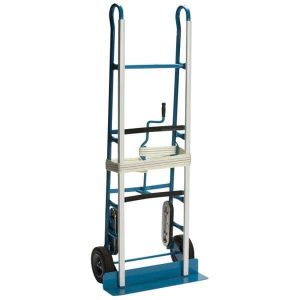
At Commander Warehouse, we are often asked by operations managers outfitting facilities across Western Canada whether they should use a hand truck or a platform truck. The decision comes down to three things: what you’re moving, where you’re moving it, and how your operators will interact with the load. Get those three right, and the answer is straightforward.
Learn some proper loading techniques for maximizing stock cart capacity.
The Core Design Difference
These tools are built around fundamentally different handling approaches:
A hand truck is an upright, two-wheel design. The load tilts back onto the frame during transport, and the operator controls balance while walking behind. Narrow, easy to store, and built for vertical loads.
A platform truck is a flat, four-wheel deck. Loads sit stable on the surface and the operator pushes or pulls. Built for horizontal stability and heavier, more varied loads.
Matching Equipment to Load Type
Use a hand truck when you’re moving stacked boxes or cartons from receiving to shelving, bagged materials, kegs, or cylinders, and appliances or upright equipment with a uniform, stackable profile.
Use a platform truck when you’re moving single heavy items that can’t stand vertically, multiple smaller items transported together, or irregular and oversized shapes that need flat, stable support across open warehouse floors.
If your operators are regularly stacking uniform cartons, a hand truck is faster. For assembled components or mixed loads moving between workstations, a platform truck eliminates the balancing work entirely.
Space and Facility Layout
Hand trucks win in tight environments. Their narrow profile handles congested aisles and compact backrooms, and they store flat against a wall when not in use.
Platform trucks need more room to manoeuvre. They require wider aisle clearance for turns and are best suited to open warehouse floors, loading docks, and staging areas. Before committing to platform trucks, measure your narrowest aisle and tightest turn radius.
One situation where the choice is clear-cut: stairs. Only hand trucks can navigate stairways, and only with the right stair-climber configuration. Platform trucks are floor-level only.
Operator Ergonomics and Physical Demand
Hand trucks require proper loading technique. The operator lifts the load onto the toe plate and manages the tilt angle in motion. Using this type of equipment carries real injury risk if technique is inconsistent.
Platform trucks reduce that demand significantly. Loads slide onto the deck, and pushing or pulling on flat surfaces puts far less strain on backs and shoulders. In high-volume operations where the same equipment gets used hundreds of times per day, that ergonomic difference compounds quickly into injury rates and lost time.
Make the Right Call for Your Operation
Tall, stackable loads through tight spaces: use a hand truck. Heavy, irregular, or bulk loads across open floor space: use a platform truck. Many facilities need both.
At Commander Warehouse, we’ve spent over 50 years helping Western Canadian operations equip their facilities correctly the first time. If you need help selecting the right equipment for your workspace, fill out the contact form on our website and one of our experienced sales representatives will help you make an informed decision.


