How Mobile Shelving Compares to Static Shelving Systems
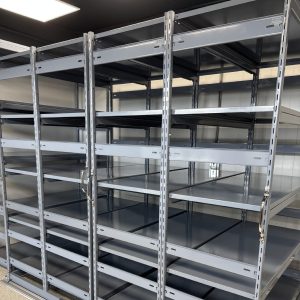
When operations managers run out of floor space, the instinct is often to look at a bigger facility. At Commander Warehouse, we’ve spent over 50 years helping Western Canadian operations solve that problem before it gets that far. Understanding how mobile shelving compares to static shelving systems is one of the most practical conversations we have with clients, and the answer almost always depends on what they’re actually storing and how often they need to get to it.
The Core Difference Between the Two Systems
Static shelving is fixed in place. Aisles are permanent, access is constant, and the layout stays the same unless you physically move the units. It’s the conventional approach and still the right choice in many situations.
Mobile shelving, also called compact or high-density shelving, mounts on floor tracks and moves laterally. Instead of multiple fixed aisles, you have one active aisle that shifts to wherever you need it. The result is significantly more usable storage in the same footprint.
Neither system is universally better. The right choice comes down to three operational factors: how frequently inventory is accessed, how much floor space is available, and what the facility is actually trying to accomplish.
When Static Shelving Makes More Sense
Static systems are still the right call for a lot of industrial applications. Here’s where they consistently outperform mobile systems:
- High-frequency picking environments where multiple staff need simultaneous access across different sections
- Manufacturing floors and production areas where open aisle access is tied to workflow, not just storage
- Operations with limited upfront capital where system simplicity and lower installation cost matter more than density
- Facilities with uneven or structurally complex floors that aren’t suited for track installation
- Retail stockrooms and small distribution areas where fast turnover makes constant aisle access the priority
Static systems are also easier to reconfigure. If your inventory mix changes, you can shift and rebuild units without dealing with track layouts or floor anchoring.
When Mobile Shelving Delivers a Clear Advantage
The case for mobile systems gets stronger as floor space becomes more constrained and inventory volume grows. These systems are particularly well-suited to:
- Archive and records storage where retrieval happens at lower frequency
- Parts storage and tool cribs in automotive and manufacturing environments
- Distribution centres and warehouses managing high SKU counts with limited square footage
- Healthcare and institutional facilities where both density and controlled access matter
- Operations facing expansion pressure that want to maximize existing space before committing to a larger facility
The fundamental trade-off is straightforward: you give up simultaneous multi-point access in exchange for significantly more stored volume per square metre. For operations where one active aisle at a time is acceptable, that trade is usually worth making.
Key Comparison Points
Floor Space and Storage Density
Mobile systems consolidate aisles, which is where most of the floor space in a static layout goes. By eliminating fixed dead aisles, you get measurably more rack or shelf face within the same bay. For facilities operating near capacity, this can defer or eliminate the need for expansion entirely.
Learn all about properly distributing weight on multi-tier shelving systems.
Upfront Cost vs. Long-Term Value
Static shelving costs less to purchase and install. Mobile systems carry a higher upfront investment due to the track system, carriages, and structural requirements. When the alternative is leasing additional warehouse space or building out a new facility, though, the math often shifts in favour of mobile over a three-to-five year horizon.
Access Patterns and Workflow
This is where most decisions get made. If your team is pulling orders continuously throughout the day across a wide range of SKUs, a static layout keeps everyone moving without interference. If your storage is more archival, think parts inventory, seasonal product, or raw material stock, mobile systems work well because the access frequency doesn’t demand permanent open aisles.
Learn how to organize high-volume picking operations without adding floor space.
Floor Loading and Structural Requirements
Mobile shelving concentrates load differently than static systems. Before specifying a high-density system, floor load capacity needs to be confirmed. This is a non-negotiable step in the planning process.
Reconfigurability
Static shelving wins here. Units can be repositioned, expanded, or reduced with minimal disruption. Mobile systems are more permanent by nature, so track layouts require planning and commitment upfront.
Matching the System to the Operation
The facilities we work with across Western Canada don’t all have the same problem. A parts distributor managing thousands of SKUs in a tight footprint has a different challenge than a manufacturing shop that needs fast, open access to raw materials throughout the shift.
The decision framework is straightforward: start with access frequency, then evaluate floor space constraints, then look at budget across a realistic time horizon. If simultaneous multi-point access is critical to daily operations, static shelving is likely the right call. If density and space optimization matter more than constant open-aisle access, mobile systems are worth a serious look.
If you’re weighing these options for your facility, we’re set up to help you work through the specifics. Reach out to our team through our contact form and let’s look at what your operation actually needs.


