Push Back Racking vs Drive-In Racking
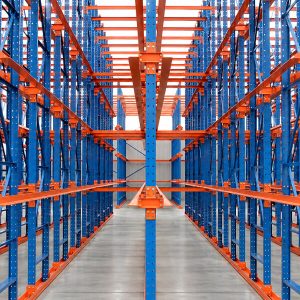
When warehouse managers across Western Canada start asking about high-density storage, the conversation usually lands on two systems: push back racking vs drive-in racking. Both are LIFO configurations that eliminate excess aisles and pack more product into your footprint. But they perform very differently in practice, and choosing the wrong one creates operational drag that compounds every single shift. At Commander Warehouse, we’ve seen both systems succeed and fail depending on how well they matched the operation running them.
How Each System Actually Works
Push back racking uses a cart-and-rail system on a slight incline. Each incoming pallet pushes the previous one back along the rails. When you pull a pallet, the ones behind it roll forward automatically. Forklifts load and unload from the aisle face only; they never enter the structure.
Drive-in racking works differently. The forklift drives directly into the rack bay, placing pallets on continuous horizontal rails at height. You’re working from the inside out, and everything rides on operator precision once they’re inside that structure.
Same LIFO logic, fundamentally different mechanics. That distinction drives everything else.
Storage Density: Where Drive-In Has the Edge
If raw density is the primary objective, drive-in racking wins. Eliminating forklift aisles between bays lets you push floor space utilization significantly higher than most other configurations. It’s the default choice in cold storage and beverage distribution for exactly this reason: every insulated square foot carries a real dollar cost, and drive-in delivers more usable positions per square metre than any comparable system.
Push back racking still outperforms selective racking for density, but it requires a modest lane footprint to accommodate the cart mechanism. The trade-off is intentional. You’re not optimizing for pure density; you’re optimizing for accessible density.
Selectivity: Where Push Back Earns Its Keep
This is usually the deciding factor, and it’s the one most operations managers underestimate.
With drive-in racking, each lane is a single product lane by necessity. To access a pallet that isn’t at the face, you pull everything in front of it. That’s manageable when you’re running a handful of SKUs at massive volume. It becomes a serious throughput problem when your SKU count climbs.
Push back racking gives each lane independent access. A forklift working one lane doesn’t block another. Multiple operators can work the high-density zone simultaneously without creating a bottleneck at a single entry point. If your high-density storage zone holds more than a handful of different SKUs, push back will outperform drive-in on throughput, not because the mechanics are faster in isolation, but because it doesn’t force operational compromises.
Learn how to organize a high-volume picking operation without adding floor space.
Forklift Exposure and Rack Integrity
Drive-in racking asks a lot of your forklift operators. Maneuvering inside a rack structure at depth and height, repeatedly, across shifts, even skilled operators can make contact with uprights and rails. That contact accumulates. Drive-in racks require more frequent structural inspections and see meaningfully higher damage-related repair costs over their service life.
Push back racking keeps the forklift out of the structure entirely. The mechanical exposure is to the cart system, which is designed to take that load. Rack uprights stay cleaner, structural integrity holds longer, and you spend less time and money on damage remediation. In high-throughput environments where racks are being worked continuously throughout the day, that difference adds up fast.
Choosing the Right System
Neither system is universally superior. Here’s how to think about it:
Drive-in racking fits better when:
- SKU count in the high-density zone is very low, with three to five products running at high volume
- Maximizing raw floor utilization is the primary driver, as in cold storage or seasonal buffer storage
- Operators are experienced and safety protocols are well-established
- Budget favours lower upfront equipment cost
Push back racking fits better when:
- You’re storing moderate SKU variety and need each lane to hold a distinct product
- Throughput demands require faster, more flexible load and unload cycles
- You want to limit forklift exposure to the rack structure over the long term
- Operator skill levels vary across shifts
Also worth factoring in before you decide:
- Ceiling height and floor load capacity affect what’s feasible regardless of which system you prefer
- Whether you’re retrofitting existing selective racking or designing from a clear floor changes the cost picture considerably
- Forklift fleet compatibility matters, particularly for drive-in configurations that require specific mast and carriage specs
Find out what to look for when buying used pallet racking.
The Total Cost View
Purchase price alone is a poor basis for this decision. Drive-in racking typically costs less upfront, but factor in rack repair frequency, forklift maintenance from structural contact, and labour time lost to lane access constraints, and that gap narrows or reverses depending on your throughput volume. Push back racking carries a higher initial investment, but operations running it in the right application tend to see that cost absorbed by efficiency gains over time.
Neither system is a bad investment. Both are poor investments when they’re mismatched to the operation.
We’ve helped Western Canadian warehouses across manufacturing, distribution, and industrial sectors work through exactly this decision. If you’re weighing these two systems and want a practical assessment based on your SKU profile, floor plan, and throughput requirements, reach out to our team through our contact form and we’ll get into the specifics with you.


