Understanding Seismic Requirements for Warehouse Racking
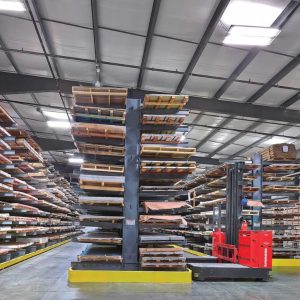
Seismic design is a baseline requirement that shapes how racking systems are specified, installed, and maintained. At Commander Warehouse, understanding seismic requirements for warehouse racking is part of how we approach every project in Western Canada, where seismic activity is a documented engineering consideration, not a theoretical one. Getting this right from the start protects inventory and the people working around it every shift.
Learn how to store oversized items on pallet racks.
How Seismic Zones Affect Racking Design
Canada uses the National Building Code (NBC) to establish seismic hazard levels by location, and those hazard levels directly influence the structural demands placed on racking systems.
Key design factors include:
- Spectral acceleration values specific to the installation site, which determine the lateral loads a rack must resist
- Importance factor, which accounts for building occupancy and the consequences of structural failure
- Rack configuration, including height, bay spacing, and load distribution, all of which affect how seismic forces travel through the system
- Floor slab condition and anchor capacity, which set the upper limit on what any bracing configuration can actually achieve
In high-seismic zones like coastal British Columbia, these factors combine to produce significantly higher lateral force requirements than what you’d see in lower-risk regions. Racking that’s code-compliant in Alberta may not meet the same threshold on Vancouver Island.
RMI and CSA Standards for Seismic Compliance
Rack manufacturers and installers in Canada work to two primary standards: ANSI/RMI MH16.1, which governs the design, testing, and utilization of industrial steel storage racks, and CSA A344, the Canadian standard specifically addressing the design and installation of steel storage racks.
Both standards require that seismic analysis be performed using site-specific data. A generic rack spec doesn’t hold up. Every installation needs calculations tied to the actual location and load conditions.
What Proper Seismic Design Looks Like
A compliant seismic racking installation typically includes column base plates and anchor bolts sized for lateral load transfer to the floor slab, spine bracing or cross-aisle bracing designed to absorb seismic energy without permanent deformation, and row spacers and horizontal ties that maintain frame alignment under lateral movement. All of it needs to be backed by engineering drawings stamped by a registered professional engineer for the province.
Floor anchoring is one of the most frequently under-specified elements. Anchor bolt diameter, embedment depth, and spacing all need to match the seismic demand calculated for the site.
Common Gaps in Seismic Racking Installations
Even when the original install is done correctly, issues emerge over time. Loads exceeding the original design parameters without a re-analysis, anchor bolts that have loosened or corroded without being flagged during inspections, rack damage from forklift impacts that compromises the system’s lateral capacity, and unauthorized modifications to bracing or frame configurations are all common failure points. Any one of them can reduce a rack’s seismic performance without being immediately visible during routine walkthroughs.
Learn how to prevent overloaded shelving systems.
Getting the Specification Right
Seismic compliance comes down to site-specific engineering, the right structural components, and an installation executed to the stamped drawings. Skipping any part of that process creates liability and real physical risk.
If you’re specifying or replacing racking in your facility and want to make sure the seismic design holds up to scrutiny, reach out to us through our online contact form and we’ll work through the requirements with you.


