Why Aisle Width Matters More Than Most Warehouse Managers Think
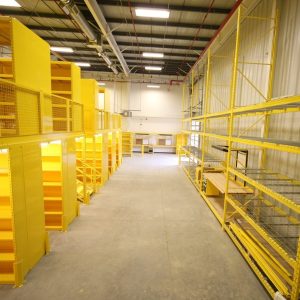
At Commander Warehouse, we’ve seen facilities locked into inefficient layouts long after their equipment mix has changed, and aisle width is almost always part of the problem. The wrong clearances don’t just slow your operation down; they force every other decision around them. Racking configurations, forklift selection, throughput capacity: all of it flows from what’s happening at floor level.
Get help with shelving layout design for awkward spaces.
The Real Cost of Undersized or Oversized Aisles
Aisle width is an active variable that shapes daily operations in ways that compound over time. Too narrow, and you’re restricting equipment manoeuvrability, increasing cycle times, and putting rack integrity at risk every time a lift operator misjudges clearance. Too wide, and you’re burning square footage that could be generating storage density.
The tension is real: maximizing storage density and maintaining workable throughput pull in opposite directions, and aisle width is where those forces meet.
How Forklift Type Dictates Minimum Clearances
Your equipment selection and your aisle width are not independent decisions. Each lift category carries different turning radius and clearance requirements:
- Counterbalance forklifts need the widest aisles, typically 11 to 12 feet for standard operation in a racked environment.
- Reach trucks operate effectively in narrow aisles down to roughly 8 to 9 feet and are built for exactly this kind of density-focused layout.
- Very narrow aisle (VNA) equipment, including turret trucks and man-up order pickers, can work in aisles as tight as 5 to 6 feet, but they require guidance systems and specific floor flatness tolerances to do it safely and efficiently.
Mixing equipment categories without adjusting aisle specs is one of the more common layout mistakes we see. A reach truck spec’d for an 8-foot aisle doesn’t perform the same way when a counterbalance ends up covering the same zone.
Learn all about first-in-first-out storage solutions.
Aisle Width and Racking System Compatibility
Selective Racking
Selective pallet racks are forgiving in terms of aisle width because they don’t require specialized lift equipment. The trade-off is storage density: you’re trading floor space for accessibility.
Drive-In and Push-Back Racking
These systems deliberately reduce aisle count to increase storage depth. Aisle width matters less here, but equipment compatibility tightens considerably.
Pallet Flow Racking
Pallet flow systems use gravity to move product through a lane, so aisle requirements shift toward the entry and exit faces rather than lateral manoeuvring space.
Matching rack type to aisle layout, then confirming both against your lift equipment specs, is a step that gets skipped too often during facility reconfigurations.
Getting the Layout Right Before Committing to Equipment
Aisle width decisions made in isolation create problems that are expensive to undo. Slab modifications, re-anchored racking, and equipment replacements add up fast.
At Commander Warehouse, we work with operations teams across Western Canada to align racking systems, equipment selection, and floor layout before procurement decisions get locked in. If your facility is running into throughput bottlenecks or you’re planning a reconfiguration, reach out through our contact form and we’ll look at what’s actually driving the constraint.


