Cantilever vs. Selective Pallet Racking
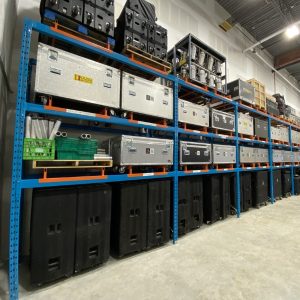
At Commander Warehouse, we field this question regularly from operations managers and procurement teams across Western Canada: cantilever or selective pallet racking, which one belongs in your facility? The answer depends entirely on what you’re storing and how your team needs to access it. Understanding the structural logic behind each system makes the decision straightforward.
How Each System Is Built
Selective Pallet Racking
Selective racking is the standard workhorse of pallet storage. It uses a series of upright frames connected by horizontal load beams, creating bays sized to hold standard palletized loads. Forklifts access each pallet position directly from the aisle. The design is modular, adjustable, and compatible with virtually every standard forklift on the market.
Cantilever Racking
Cantilever racking takes a fundamentally different approach. Vertical columns anchor to a base, with horizontal arms extending outward, no front column obstructing the face of the rack. That open face is the defining feature. It allows long, irregularly shaped, or bundled materials to be loaded and retrieved without obstruction.
What Each System Is Built For
This is where most selection decisions should begin. The inventory, not the budget, should drive the choice.
Selective pallet racking suits palletized goods in standard box or container formats, operations with high SKU counts requiring individual pallet access, distribution centres, retail warehouses, and general manufacturing storage, and FIFO inventory rotation requirements.
Cantilever racking suits lumber, structural steel, pipe, and tubing, along with sheet goods, rolled materials, carpet, and fabric. It’s the right call for building material yards, millwork operations, and any load that overhangs a standard pallet or lacks a rigid base.
Trying to store long or irregularly shaped materials on selective racking creates handling problems fast. The same is true in reverse. Using cantilever for standard palletized goods adds cost without adding function.
Find out what to look for when buying used pallet racking.
Space, Aisle Width, and Density Trade-Offs
Neither system is inherently more space-efficient. Each one optimizes for a different kind of load.
Selective racking works best in facilities with standard ceiling heights and aisle configurations suited to counterbalance or reach trucks. It delivers strong storage density for palletized goods and scales well as inventory grows.
Cantilever racking requires wider aisles to accommodate the arm extensions and the long materials being moved. Facilities storing lumber or pipe are already dealing with equipment, whether forklifts with extensions, cranes, or side-loaders, that determines aisle requirements regardless of racking type. The open-face design of cantilever actually improves throughput in those environments because there’s no column interference during loading.
The real density question is this: are you measuring positions per square foot, or are you measuring the ability to actually store and retrieve what you have? A selective rack full of 20-foot lumber is not a functional storage system.
Load Capacity and Structural Considerations
Both systems handle substantial loads when specified and installed correctly. A few distinctions worth knowing:
- Selective racking beam capacities are rated by the pair and calculated against uniformly distributed pallet loads.
- Cantilever arm capacities are rated individually per arm, which matters when loads are unevenly distributed along the length of the material.
- Column spacing on cantilever systems needs to account for the longest materials being stored, affecting how the system is configured, not just how tall it goes.
- Both systems require floor anchoring and must be specified against the seismic and load requirements applicable to your region.
In Western Canada, seismic considerations are not optional. Any racking installation needs to be designed with local building code requirements factored in from the start.
Making the Call: A Practical Decision Framework
If your inventory is ambiguous or your facility stores a mix of load types, work through these questions:
- What percentage of your SKUs are standard palletized goods? If the answer is the majority, selective racking covers your core need.
- Do you store any materials that extend beyond a standard pallet footprint? If yes, cantilever deserves serious consideration for those SKUs, even as a secondary system.
- What handling equipment do you already operate? Racking and equipment compatibility should be assessed together, not separately.
- What does your picking workflow look like? High-frequency, individual-pallet access favours selective. Low-frequency, large-load retrieval favours cantilever.
Many facilities run both. A building materials distributor might use selective racking for hardware and packaged goods alongside cantilever for dimensional lumber and sheet stock. That combination is common and practical.
Getting the Right System Configured for Your Facility
Selecting the racking type is step one. Configuring it correctly for your specific floor plan, load profile, and equipment is where the actual work happens. A poorly configured selective system loses usable positions. An under-specified cantilever system creates safety and handling problems that show up fast under real operating conditions.
At Commander Warehouse, we bring over 50 years of material handling experience to these decisions, with onsite reviews conducted by sales reps who understand Western Canadian operations. If you’re evaluating pallet racking options and want a straightforward assessment of what fits your facility, reach out through our contact form.


