Understanding Load Beam Capacity in Pallet Racking
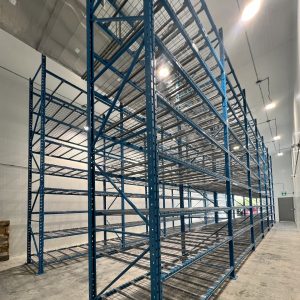
At Commander Warehouse, we’ve spent over 50 years watching operations make the same costly mistake: choosing pallet racking based on upright capacity alone while treating load beam capacity as an afterthought. Understanding load beam capacity is the foundation of a safe, code-compliant storage system. Get it wrong and you’re looking at damaged product, regulatory exposure, or worse.
What Load Beam Capacity Actually Means
Beam capacity is the maximum load a pair of beams can support across a single storage level. That “pair” distinction matters more than most people realize.
Manufacturers publish capacity ratings per beam level, meaning the total weight distributed evenly across both beams and the full span between them. This is not a per-beam figure. A rating of 4,000 lbs means both beams together hold 4,000 lbs, not 4,000 lbs each.
Two variables drive that number above everything else:
- Beam length (span): The longer the span between uprights, the lower the capacity. A 96-inch beam pair will carry significantly less than a 72-inch pair of the same profile.
- Beam profile: The cross-sectional shape and material gauge determine how much load the beam can handle before it deflects or fails. Deeper profiles with heavier gauge steel carry more.
These aren’t interchangeable. A beam that performs well in one configuration may be dangerously underrated in another.
Learn all about the seismic requirements for warehouse racking.
How to Determine Your Required Capacity
This is where operations teams need to slow down and do the math before purchasing.
Calculate Your Actual Load Per Level
Start with the heaviest pallet combination you’ll ever store on a single beam level, not your average load, but your worst case. Add product weight to pallet weight, then account for how many pallets sit on that level. That total needs to fall comfortably below your beam pair’s rated capacity.
Apply a Practical Safety Buffer
Never load a beam level to its published maximum. Industry practice calls for working loads that leave meaningful margin below the rated capacity. Loads shift during forklift placement. Pallets are rarely perfectly balanced. Cumulative wear on the racking over time affects performance. Build the buffer in from day one.
Account for Load Distribution
Rated capacity assumes evenly distributed load. In practice, that assumption breaks down regularly:
- Product concentrated toward one end of a pallet
- Pallets placed off-centre on the beams
- Awkwardly shaped loads that don’t sit flat
Any of these conditions stress the beams beyond what the rating anticipates. If uneven loading is common in your operation, factor that into your capacity requirements from the start.
Canadian Standards and What They Require
In Canada, pallet racking falls under CSA A344, which governs the design and performance of industrial storage racks. This standard shapes how manufacturers test and publish load ratings, and it establishes baseline requirements for capacity labelling and load notices posted at rack locations.
Your racking system is required to display a load capacity placard. That placard needs to reflect the actual configuration: beam length, beam profile, upright spacing, and bay loading. If you reconfigure the system after installation, the placard has to be updated to match. Running a system under a placard that no longer reflects reality is a compliance problem, full stop.
Common Capacity Mistakes Worth Avoiding
Operations teams get into trouble in predictable ways, such as:
- Confusing beam pair capacity with per-beam capacity: Doubling the listed number because you see two beams isn’t how the rating works.
- Mixing components from different systems: Beams and uprights from different manufacturers often have incompatible connection points and unverified combined capacities. A system is only as reliable as its weakest connection.
- Ignoring deflection: A beam that sags visibly under load may still be within rated capacity, but visible deflection is a signal worth taking seriously. The CSA standard includes deflection limits for a reason.
- Assuming the original configuration is permanent: Operations evolve. When product weights increase or bay configurations change, the original capacity rating may no longer apply. Re-evaluate every time the system changes.
- Relying on what the previous operator told you: Racking that came with a facility may have unknown history, such as repairs, modifications, or unlabelled replacements. Treat it as unverified until you know otherwise.
Find out what you should look for when buying used pallet racking.
Matching Beam Selection to Your Operation
When you’re specifying beams for a new installation or replacing components in an existing system, a few decisions matter most:
- Select beam length based on your upright spacing, not the other way around
- Match beam profile to your actual worst-case load requirements with buffer included
- Confirm the beam-to-upright connection is rated and compatible for your specific uprights
- Verify that your capacity placard reflects the configuration as-installed
Working with someone who understands both the product specifications and how real warehouse operations actually run makes this considerably less complicated.
Getting the Configuration Right from the Start
Load beam capacity isn’t where you want to discover you made assumptions. At Commander Warehouse, our team works directly with operations managers and procurement teams across Western Canada to match racking specifications to real load requirements, before anything gets installed. If your operation is expanding, reconfiguring, or you’re not confident the current setup is properly rated, reach out through our contact form and we’ll put experienced eyes on it.


