How to Configure Cantilever Racking for Pipe and Lumber
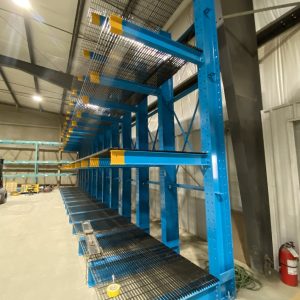
At Commander Warehouse, we work with operations that store long, unwieldy materials: pipe strings, dimensional lumber, steel bar, engineered joists. The configuration decisions made at the rack design stage determine whether that storage works or becomes a daily frustration. Knowing how to configure cantilever racking for pipe and lumber isn’t just a matter of fitting product into a bay; it’s about matching arm capacity, column spacing, and base geometry to the actual load profile you’re running.
Start With Your Load Data, Not Your Floor Plan
Most configuration problems trace back to the same mistake: planning around available floor space before understanding the load. Before any layout work begins, you need four things:
- Material lengths: Are you storing 20-foot pipe, 16-foot studs, or mixed-length dimensional lumber? Arm projection and column spacing hinge on this.
- Bundle weights and individual piece weights: Cantilever arms are rated per arm, not per bay. Know your heaviest anticipated load per arm position.
- Load distribution: Pipe in bundles distributes weight evenly. Loose lumber stacked on a single arm point-loads differently. Both scenarios require different arm gauge selections.
- Stack height: How many levels of material will you be running, and what does that do to your base moment load?
Working from actual load data prevents both undersizing (a safety issue) and oversizing (a cost issue).
Learn all about the seismic requirements for warehouse racking.
Single-Sided vs. Double-Sided Configurations
Single-Sided Cantilever
Single-sided systems are wall-mounted or freestanding with arms extending in one direction only. They work well for operations with limited aisle width, facilities storing against a wall or where one-side access is sufficient, and situations where load weights are uneven and back-to-back balancing isn’t practical.
The trade-off is a significant overturning moment at the base. Column and base sizing must account for the full eccentric load without a counteracting arm on the opposite side.
Double-Sided Cantilever
Double-sided systems extend arms in both directions from a central column. For pipe and lumber yards, this configuration is often more efficient: it uses both faces of the aisle, the base moment is partially offset when both sides carry comparable loads, and throughput is higher when pickers work both faces simultaneously.
Where double-sided systems create problems is when loads are chronically imbalanced, heavy material on one side and light or empty on the other. Design for your realistic operating condition, not your ideal one.
Learn all about some alternative racking arrangements for warehouses.
Configuring for Pipe Storage
Pipe presents a specific challenge: it wants to roll. Configuration decisions need to account for that directly.
- Arm pitch: A slight downward pitch toward the column (typically 2 to 5 degrees) keeps pipe from migrating toward the aisle edge under its own weight.
- Arm lips or load stops: Pipe that shifts during loading or seismic events is a serious problem. Use lip arms or bolt-on load stops rated for the pipe diameter you’re carrying.
- Arm spacing: For unsupported pipe spans, tighter arm spacing reduces sag on lighter-wall material. Heavier schedule pipe can tolerate wider spans, but verify against the pipe’s own deflection characteristics.
- Bundle management: If you’re storing bundled pipe, confirm that banding tension doesn’t concentrate load onto a single arm edge. Flat bar or saddle arms distribute bundle weight more evenly than standard tubular arms.
Configuring for Lumber Storage
Lumber brings moisture content variation, inconsistent bundle geometry, and significant weight per linear foot for engineered products like LVL and PSL.
- Arm capacity selection: Kiln-dried dimensional lumber is forgiving. Green lumber, glulam, and engineered beams are not. Size arms for worst-case moisture-loaded weight, not nominal dry weight.
- Column spacing: Lumber yards typically run 48-inch to 60-inch column spacing to accommodate standard unit lengths and allow forklift access between bays without clipping columns.
- Arm length: For standard framing lumber stored in bundles, arms typically run 36 to 48 inches. Wider arms for wider bundles introduce more bending moment, so confirm the arm gauge matches the extended load.
- Decking: Some lumber configurations benefit from plywood or steel decking across arms to prevent narrower boards from dropping through. This also allows mixed-length storage without sorting by arm position.
Aisle Width and Equipment Compatibility
The racking configuration doesn’t exist in isolation from your lift equipment. Reach trucks, sideloaders, and counterbalanced forklifts all have a different turning radius and mast height requirements that directly affect how close columns can be set and how tall the system can run. Confirm aisle width requirements against your actual handling equipment before finalizing column placement.
Getting the Configuration Right the First Time
Cantilever systems for pipe and lumber aren’t plug-and-play. The margin for error on arm ratings, base moment calculations, and equipment clearance is narrow enough that a configuration error typically shows up as either a safety incident or a system that can’t handle your actual inventory mix.
Our team offers onsite facility reviews across Western Canada to work through exactly these variables before any equipment is specified. If you’re configuring storage for pipe, lumber, or other long-load materials and want to make sure the system fits your operation, fill out our contact form and we’ll put the right expertise on it from the start.


