What Is Wide Span Shelving and When Should You Use It?
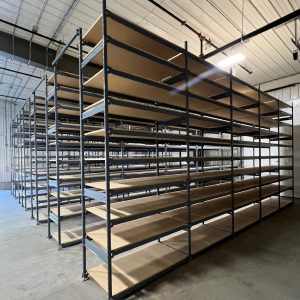
At Commander Warehouse, we get asked this question regularly by operations managers who know their current storage setup isn’t working but aren’t sure where the gap is. Wide span shelving is one of those solutions that fits a specific operational profile, and when that profile matches, it outperforms the alternatives. When it doesn’t, it creates problems. Understanding the difference comes down to load type, pick frequency, and how your team actually moves through the space.
How Wide Span Shelving Works
Wide span industrial shelving is a medium-duty, hand-loaded racking system designed for bulkier items that don’t require forklift placement. Shelf bays typically run wider than standard shelving, often in the range of four to eight feet, which is where the name comes from. Shelves are adjustable, decked with particle board, wire mesh, or steel panels depending on the load and application.
Key structural characteristics:
- Uprights and beams are bolted rather than welded, allowing reconfiguration as inventory profiles change
- Shelf decking is continuous across the bay width, unlike pallet racking which leaves open space between beams
- Load capacities are rated for hand-pick operations, typically supporting several hundred pounds per shelf level
- Bay depths range from 18 to 48 inches, accommodating a wide range of product footprints
This is not a light-duty wire shelving system, and it’s not pallet racking. It sits in the middle, built for bulk without the infrastructure that forklift-loaded systems require.
Find out if your current warehouse layout is costing your productivity.
When Wide Span Is the Right Call
The strongest use cases share a few common traits: products are too large or heavy for standard shelving but don’t require full pallet storage, and staff access the shelves directly rather than staging loads for mechanical retrieval.
Product and Pick Characteristics
Wide span shelving performs well when items are oversized or irregularly shaped, such as automotive parts, plumbing supplies, or large-format packaged goods. It suits operations where pick frequency is moderate to high and done by hand or with a pallet jack at floor level. It also works well when products are broken down from pallets and stored individually or in smaller quantities, and when SKU variety is high enough that visual access across the shelf face matters.
Industries That Use It
In Western Canadian operations, we see wide span shelving applied most often in wholesale and distribution centres managing a wide mix of mid-weight SKUs. Retail backrooms use it to stage bulk stock before it hits the floor. Manufacturing support areas rely on it for components and sub-assemblies stored at the point of use. Agricultural and industrial supply operations handling bagged, boxed, or packaged goods in non-pallet quantities are another consistent application.
If your warehouse handles any of these product types and your team picks directly from shelves, wide span is worth a serious look.
Learn all about the importance of weight distribution for multi-tier shelving systems.
Wide Span vs. Pallet Racking vs. Light-Duty Shelving
Getting this comparison right matters. Choosing the wrong system creates either wasted capacity or a safety problem.
Wide Span vs. Pallet Racking
Pallet racking is designed for forklift access and full pallet loads. If your receiving process keeps products on pallets from dock to storage, racking is the right system. But if you’re breaking pallets down and hand-stacking product, you’re working against the racking’s design. Wide span gives you the structural capacity for heavier loads with the shelf surface and accessibility that hand-pick operations need.
Wide Span vs. Light-Duty Shelving
Standard boltless or rivet shelving handles lighter loads and tighter product profiles. When product weight and bay widths push past what light-duty systems are rated for, wide span is the logical step up, without jumping to the cost and footprint of full pallet racking infrastructure.
Configuration Points That Affect Performance
The system’s flexibility is one of its strengths, but configuration decisions have a direct impact on how well it performs in practice.
Bay width affects how many shelf positions you can run per linear foot of aisle.
- Wider bays mean fewer uprights but longer reaches for pickers.
- Shelf depth should match your typical product footprint without creating dead space at the back.
- Tier height between shelves needs to account for your tallest product plus comfortable pick clearance.
- Row configuration, whether single-sided against a wall or double-sided in a freestanding run, shapes your aisle requirements and overall density.
The right configuration depends on your building dimensions, your product mix, and how your team moves through the space.
Getting the Selection Right
Wide span shelving is a practical, cost-effective solution for the right operation, but “the right operation” is the qualifier that matters. Misconfigured or misapplied, any storage system creates inefficiency instead of solving it.
If you’re evaluating storage options for a Western Canadian facility and want guidance from a team that’s assessed operations across BC and Alberta for over 50 years, reach out to us. Fill out the contact form on our website and we’ll work through the specifics with you, including product mix, floor plan, and workflow, before recommending anything.


